The Next Step Beyond Chatbots
Most people interact with AI through chat interfaces. They ask a question, receive an answer, and move on.
While this interaction model is powerful, it still requires humans to initiate every task. The AI remains passive, waiting for instructions.
A more interesting direction is emerging: autonomous personal agents.
Instead of answering questions, these systems continuously perform useful work on behalf of a user. They monitor information sources, collect relevant data, make decisions, filter noise, and proactively deliver results.
The difference is subtle but important.
A chatbot responds.
An agent acts.
The Real Problem: Information Consumption Does Not Scale
Software engineers, technology leaders, and technical enthusiasts consume information from dozens of sources:
- RSS feeds
- GitHub repositories
- Hacker News
- Reddit communities
- Technical blogs
- Product announcements
- AI research updates
- Social media discussions
The volume of content has become impossible to process manually.
Ironically, the problem is no longer finding information.
The problem is deciding what deserves attention.
Every day thousands of articles are published, hundreds of repositories trend, and dozens of new tools appear. Most are irrelevant. A few are valuable.
Finding those few valuable items is increasingly difficult.
Personal Agents as Information Filters
A personal agent changes the flow of information.
Instead of:
Sources → Human → Knowledge
the system becomes:
Sources → Agent → Human → Knowledge
The agent acts as a filtering layer.
Its responsibilities include:
- discovering content
- removing duplicates
- scoring relevance
- ranking results
- summarizing findings
- delivering actionable insights
The goal is not replacing human judgment.
The goal is preserving human attention.
NanoClaw as an Agent Runtime
One of the interesting frameworks for building lightweight personal agents is NanoClaw.
Rather than focusing on large enterprise workflows, NanoClaw enables the creation of small autonomous systems that can run continuously on inexpensive hardware.
The architecture is intentionally simple:
Scheduler
    ↓
Data Collection
    ↓
Filtering
    ↓
LLM Evaluation
    ↓
Delivery Channel
Each stage performs a specific responsibility.
This separation makes the system easier to extend and maintain.
A Practical Example
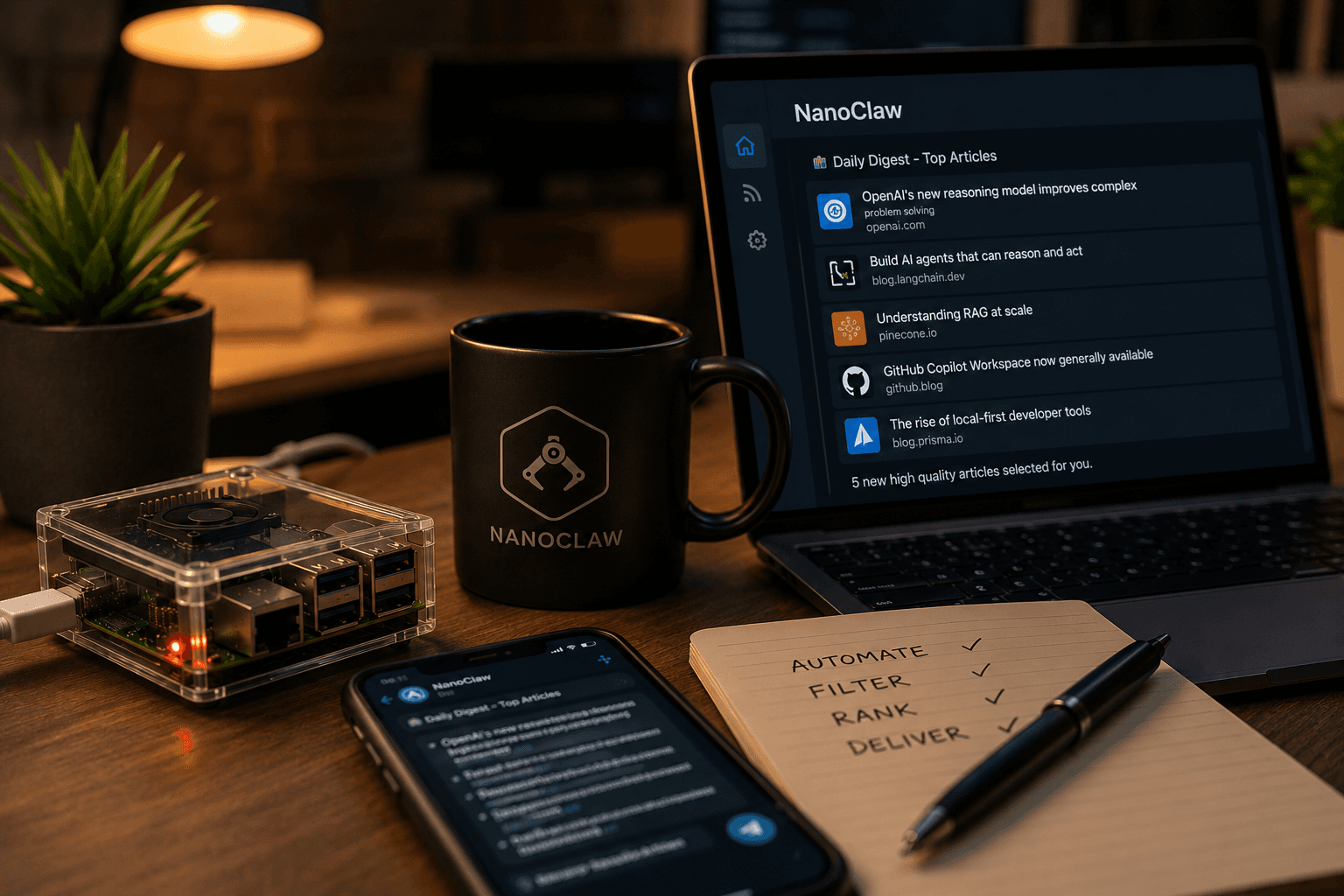
In our implementation, the agent runs continuously on a Raspberry Pi.
Its purpose is straightforward:
Collect articles from multiple technical sources and deliver only the most valuable content through Telegram.
While this sounds simple, the interesting work happens between collection and delivery.
The pipeline performs several stages:
Collection
The system aggregates content from multiple feeds and communities.
Instead of relying on a single source, it gathers a large candidate set of articles.
142 articles fetched
A large pool increases the probability of finding high-quality content.
Quality Filtering
Most content is immediately discarded.
Common filtering criteria include:
- low information density
- clickbait titles
- duplicate content
- promotional material
- irrelevant topics
The majority of collected articles never reach the next stage.
Relevance Ranking
The remaining candidates are evaluated using an LLM.
Rather than simply ranking popularity, the model attempts to answer:
Would this be interesting to this specific user?
This distinction is important.
Popularity is global.
Relevance is personal.
The most valuable article is often not the most popular one.
Delivery
The final result is delivered through a channel that already fits into existing workflows.
In our case:
Telegram
No new application.
No dashboard.
No web portal.
The information arrives where attention already exists.
Why Small Hardware Is Enough
One surprising aspect of modern agent systems is how little infrastructure they require.
The Raspberry Pi hosting this workflow performs:
- scheduling
- feed aggregation
- ranking orchestration
- storage
- messaging
The computationally intensive reasoning is delegated to cloud LLMs.
As a result, the local machine acts primarily as an orchestrator.
This architecture provides several benefits:
- low cost
- low power consumption
- continuous operation
- minimal maintenance
The agent remains available 24/7 without requiring dedicated servers.
The Importance of Memory
An agent becomes significantly more useful when it remembers.
Without memory:
Every day starts from zero.
With memory:
The system learns history.
Examples include:
- avoiding articles already sent
- tracking previously discovered tools
- remembering user preferences
- detecting recurring topics
- identifying emerging trends
Memory transforms automation into personalization.
Beyond Article Delivery
Content discovery is only one use case.
The same architecture can be extended to:
Trend Detection
Monitoring GitHub repositories and identifying rapidly growing projects.
Technical Research
Tracking specific technologies across multiple sources.
Open Source Discovery
Finding promising new tools before they become mainstream.
Personal Knowledge Management
Building curated collections of information over time.
Automated Reporting
Generating daily or weekly technical briefings.
The agent becomes a continuously operating research assistant.
The Shift Toward Ambient Intelligence
The long-term significance of personal agents is not that they automate tasks.
Software has automated tasks for decades.
The difference is that modern agents can evaluate information and make lightweight decisions.
They operate in the background.
They monitor.
They filter.
They prioritize.
They surface what matters.
This creates a new interaction model where users spend less time searching and more time consuming relevant information.
The technology fades into the background while useful outcomes become more visible.
Conclusion
The future of personal AI is unlikely to be a single chat window.
Instead, it may consist of many small autonomous systems quietly working on our behalf.
A lightweight NanoClaw deployment running on a Raspberry Pi illustrates this direction well.
The system is not attempting to replace human expertise.
Its purpose is much simpler:
Reduce noise.
Preserve attention.
Deliver the right information at the right time.
As AI capabilities continue to improve, personal agents may become one of the most practical and impactful applications of large language models—not because they answer questions better, but because they know which questions we never needed to ask.
For further implementation details, reach me out on Linkedin.
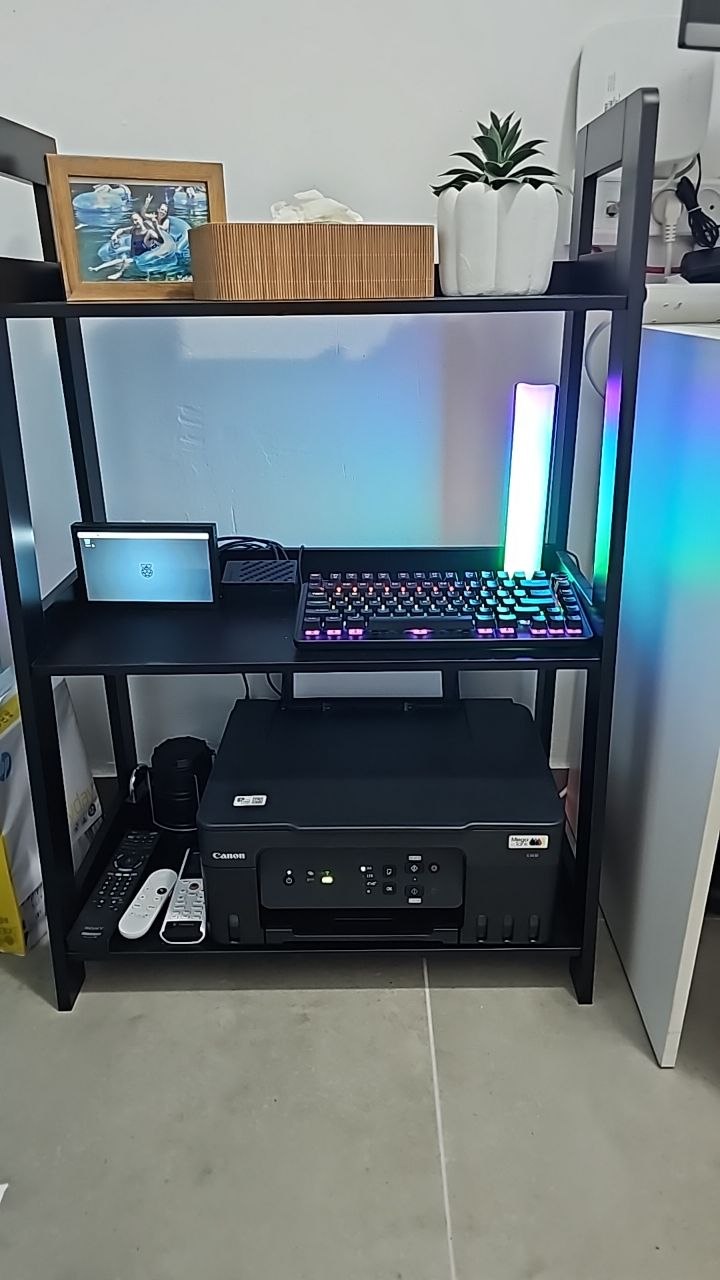 My RP Setup